
The One Framework That Stops You From Building the Wrong Thing
Why Lean Canvas should be the first thing you fill out — because clarity and focus is priceless!

This is based on personal experience and personal ignorance that was with me a lot in my early business days … That's why I feel sorry for wasted resources when I see many founders I meet building solutions to problems that don’t exist.
They’re not stupid. They’re just optimizing the wrong thing — the product — before they understand the actual problem worth solving.
A couple of failed startups later, I can tell you it is not worth the pain. Don't build for zero customers who actually care. The pattern seems to be familiar: we are often so focused on building that we forget to think.
That’s why now, I strongly recommend to every founder I work with to fill out a Lean Canvas before they write a single line of code, before they design anything. Not because I love frameworks — I actually hated most of the academic BS from business school — but because this one saves time and resources.
It exposes the lies you’re telling yourself early.
The Clarity Tax
Here’s what most founders don’t want to hear: if you can’t describe your business on one page, you don’t understand it yet. And so you most likely don't have a business, you just dream about one.
I don't mean painting your vision. Not even your long-term strategy. Your actual business — who you serve, what problem you solve, how you’ll reach them, and why they’ll pay you.
The Lean Canvas pushes you towards this clarity. It’s designed for the most dangerous phase of building: when everything is still just assumptions in your head.
And clarity is expensive. It’s painful. That’s why most people skip it.
We tell ourselves — we will “figure it out as we go,” or “we stay flexible,” or “let the market guide us.” These are all just fancy ways of saying “I’m afraid to confront what I don’t know.”
If you want a template for your GTM to use by yourself or to feed to your AI assistant — this real example playbook might be for you

Where Lean Canvas Came From
The original framework is the Business Model Canvas, created by Alexander Osterwalder. It’s elegant, comprehensive, and also completely wrong for early-stage startups.
Why? Because it assumes you already have a business.
It was created for corporate businesses.
The BMC asks you to map out your key partners, your key activities, your key resources. But when you’re pre-product, pre-revenue, maybe even pre-team, you don’t have partners or resources or activities. You have hypotheses.
Ash Maurya saw this problem and adapted the BMC specifically for startups. He called it the Lean Canvas, and he made one critical change: he replaced all the “we have this” boxes with “we need to test this” boxes.
Instead of “key partners,” you map your problem. Instead of “key activities,” you identify your unfair advantage. Instead of asking “how does our business work,” it asks “what might kill us?”
This shift is everything.
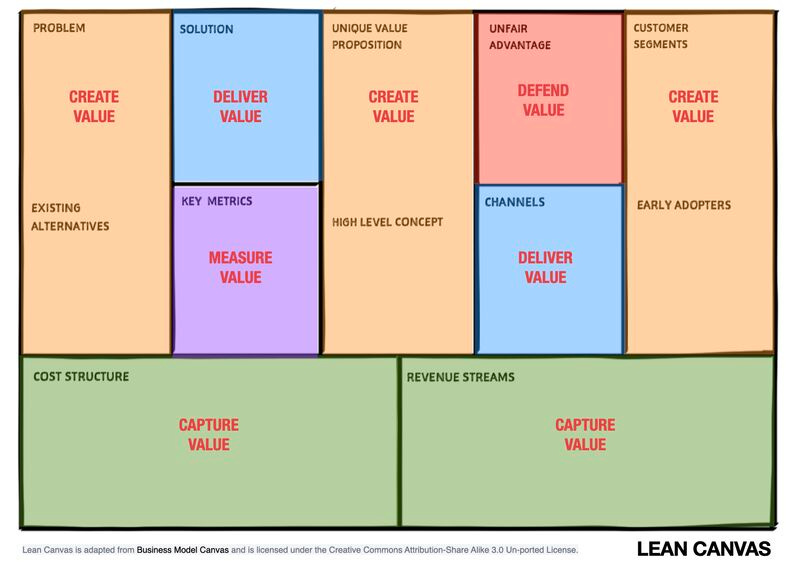
What’s Actually on a Lean Canvas
The canvas has nine boxes. Each one targets a specific risk that kills startups:
Problem — What are the top 3 problems your customers face?
If you can’t name them specifically, you’re guessing.
Customer Segments — Who has these problems badly enough to pay?
Not “everyone who wants X” but “developers at series A startups trying to scale their infrastructure.”
Unique Value Proposition — Why should someone care?
This isn’t your feature list. It’s the single, clear reason someone should stop what they’re doing and pay attention.
Solution — What’s your MVP?
Not the full vision, just the minimum feature set that addresses the top problem and works.
Channels — How will you reach these people?
Paid ads? Community? Cold outreach?
Be specific, because vague channel strategies mean no customers.
Revenue Streams — How does money flow in?
Subscription? Transaction fees? Hardware sales? License fees?
If this box is empty or hand-wavy, you don’t have a business yet.
Cost Structure — What are your biggest costs?
This forces you to think about burn rate before you’re burning.
Key Metrics — What’s the one number that tells you if this is working?
Not vanity metrics. The thing that actually indicates product-market fit.
Unfair Advantage — What do you have that can’t be easily copied?
This is the hardest box to fill, honestly, and that’s the point. Most early-stage startups don’t have one yet. Admitting that is useful.
For Software & Hardware Founders Outside Crypto
If you’re building traditional tech products, the Lean Canvas catches the problems that kill most startups in their first year.
I’ve seen SaaS founders spend six months building the perfect project management tool, complete with Gantt charts, resource allocation, and time tracking — only to discover their target customers just wanted a better way to assign tasks. The Lean Canvas would have caught this in week one by forcing them to validate the actual problem first.
Hardware founders are even more vulnerable. You can’t pivot hardware as easily as software. I watched a team spend $350K on their first production run of an IoT device for home automation, only to learn that their target market — busy parents — didn’t want another device to set up and maintain. They wanted solutions that worked with what they already had. A Lean Canvas would have forced them to test this assumption before they committed to manufacturing.
Developer tool founders often skip this entirely. They build the tool they wish existed, assume other developers want it, and launch to silence.
The Canvas asks: who specifically can’t do their job without this? Not “developers who care about code quality” but “frontend engineers at companies with 50+ developers who are shipping multiple times per day and can’t keep up with PR reviews.”
The difference between “developers” and “frontend engineers at 50+ person companies shipping daily” is the difference between guessing and knowing.
For Web3 Builders and Crypto Founders
Web3 founders are the worst at this exercise.
They spend months architecting protocols, debating token mechanics, optimizing for future decentralization — and then launch to crickets because nobody actually needed what they built. That's also true if they come only for your airdrop. 🚨
I’ve seen DeFi protocols with beautiful math and zero users.
NFT projects with stunning art and no community retention.
DAOs with perfect governance structures and no reason to exist.
The Lean Canvas would have caught all of these problems in week one. If you actually wanted them resolved.
Why? Again — because it forces you to answer the most dangerous question first: who is this for, and what problem does it solve for them?
Not “what’s the tech?” Not “what’s the vision?” Who. And what problem.
If you’re building a DeFi lending protocol, the Lean Canvas asks: who can’t get credit today, why not, and why will your solution be better than their existing alternatives? If you can’t answer that specifically, you’re building a solution looking for a problem.
If you’re launching an NFT project, it asks: what problem does owning this solve? Status? Access? Utility? Financial speculation? Be honest. If it’s speculation, own it. If it’s community, prove the community wants this.
If you’re starting a DAO, it asks: what are you coordinating that can’t be coordinated better through a Discord server? Why does this need to be on-chain? What’s the actual unfair advantage?
Most crypto projects can’t answer these questions. That’s why they fail.
The problem isn’t the technology. It’s that founders are building infrastructure for problems that either don’t exist or can be solved more easily without crypto.
The Web3 Lean Canvas Adaptation
The original Lean Canvas wasn’t built for token economies. So I adapted it.
I’ve been using a modified version for my occasional work with Web3 teams for the past two years. It adds boxes for token mechanics, governance roadmap, decentralization risks, liquidity strategy, and attack surfaces.
Because in true Web3 fashion, you’re not just building a product. You’re building an economy. And economies have different failure modes than products.
You need to think about:
How tokens flow through your system
What incentivizes each participant
How governance evolves over time
Where your protocol is vulnerable to gaming
What happens when speculation dries up
If you want to try it, just ping me, and I'll send it over.
But here’s what matters now: even the basic Lean Canvas will save you months of wasted work.
How to Actually Use This - Regularly
Don’t treat the canvas like homework. Treat it like a mirror.
Fill it out in one sitting. Don’t overthink it. Write down your honest answers, not the answers you wish were true. Do it with the team, if you have one.
Then show it to someone whose opinion you trust. Not your co-founder — they’re as delusional as you are. Someone who will tell you the truth.
If they don’t immediately understand what you’re building from reading your canvas, you need to rewrite it.
If your “unfair advantage” box is full of bullshit like “passionate team” or “first mover advantage,” delete it and start over.
If your “problem” box lists problems you think people should have instead of problems they actually have, you’re already failing.
The canvas is a tool for confronting reality. Use it that way.
When to Revisit It
Your first canvas will be wrong. That’s fine. The point isn’t to be right — it's to be forced to think about these things, it’s to be explicit about your assumptions so you can test them.
You can use it as a regular reflection tool (or not) — Every time you learn something significant about your customers or market, update your canvas. When you pivot, fill out a new one. When you’re fundraising, use it to see if your story holds together.
The founders who win aren’t the ones who nail it the first time. They’re the ones who notice they’re wrong quickly, before they’ve burned through all their runway.
The Lean Canvas can be how you notice.
The Real Reason This Matters
Most startup advice is about execution. How to hire. How to raise capital. How to build product. And it all matters and is genuinely useful.
But execution doesn’t matter if you’re executing on the wrong thing.
The Lean Canvas is about thinking. It's a thinking tool.
It’s about forcing yourself to articulate what you’re doing, why it matters, and how you’ll know if it’s working.
That sometimes feels harder than building, harder than fundraising, harder than recruiting.
But it can also be the one thing that determines whether you waste the next two years of your life building something nobody wants.
So try it. — One page. — Nine boxes. — One hour.
Stop building. Start thinking.
Then build the thing people actually need and will be happy to pay for.
Resources:
Lean Canvas template: leanfoundry.com/tools/lean-canvas
Web3 Lean Canvas: message me and I'll send it to you
Running Lean by Ash Maurya: The definitive book on this framework
Till next time, let’s BUILD BETTER!
Pete